Part 1

“A woman who hides her baby behind tablecloths doesn’t deserve to keep her,” declared Veronica, the restaurant manager, as she snatched the name badge off Maya’s uniform. “When Mr. Sterling finds out, you’re going to lose your job—and your daughter.”
Maya didn’t answer. Her throat was tight, her knees trembling. Her eight-month-month-old daughter, Chloe, had vanished from the small storage closet where she had left her sleeping. At the end of the service corridor, only one door stood open: the entrance leading down into the owner’s private basement office.
Maya was twenty-seven and worked as a waitress at Laurel, an upscale restaurant in downtown Chicago where an appetizer cost more than her entire weekly grocery budget. That morning, Mrs. Gable—her elderly neighbor and only trusted babysitter—woke up with a dangerously high fever.
Maya had called five different people. No one could step in. A last-minute daycare asked for $120 for the full shift. Maya had $24 in her checking account, her rent was due in four days, and she already had two tardy strikes on her work record.
Missing a shift meant losing her job.
So, she had slipped through the employee delivery entrance with Chloe wrapped in a soft yellow blanket. She stashed formula, diapers, and a plastic rattle inside her backpack. In the clean linen supply closet, she set up a small, safe corner far from chemical cleaning agents and heavy boxes.
She knew it wasn’t right.
She also knew she had no other choice.
She checked on Chloe at 3:15 PM and again at 4:02 PM. The baby was sleeping peacefully. But at 5:08 PM, Maya found the blanket tossed on the floor, her backpack wide open, and the supply closet door swung completely open.
Her world collapsed.
She searched the kitchen, the staff restrooms, behind the bar, and around the walk-in freezer. Veronica followed her under the guise of concern, though there was a strange glint in her eyes—a quiet satisfaction that Maya couldn’t quite fathom.
Then, they heard a soft, faint sound coming from beneath the restaurant floorboards.
The heavy dark-oak door leading down to Alexander Sterling’s private basement office was slightly ajar. Nobody entered that space without explicit permission. It was said that Sterling could close a million-dollar corporate deal with a single phone call and fire an executive without ever raising his voice.
Maya descended the stairs, barely daring to breathe.
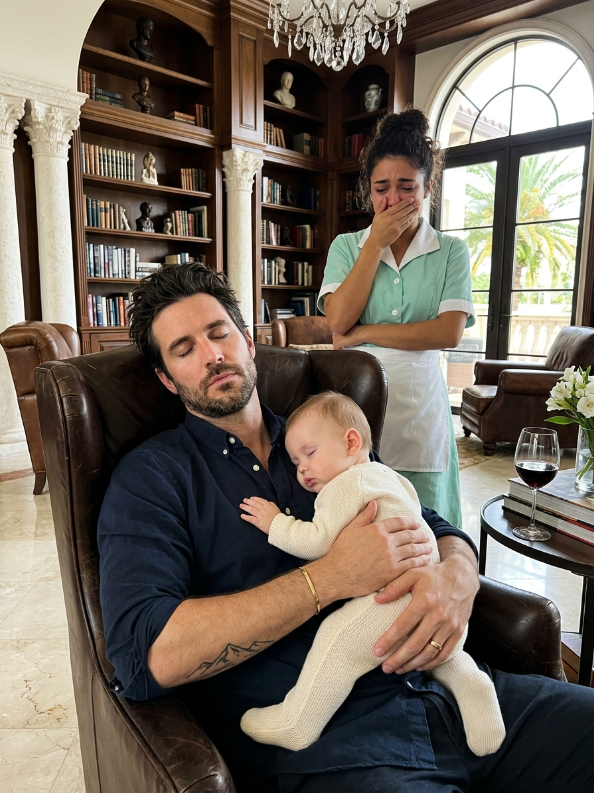
Inside the softly lit office, Alexander sat in a deep leather armchair. Chloe was fast asleep against his chest, her tiny fist clutching the lapel of his tailored suit jacket. He held the baby’s back with an unexpected, profound gentleness—as if protecting something he had been searching for for years.
When he looked up, Maya began apologizing frantically through her tears.
“I found her on the bottom step,” he said softly. “She didn’t cry. She just looked at me and reached up her arms.”
Maya babbled out the entire story in a rush of panic. She told him she would accept her immediate termination, but begged him not to call Child Protective Services before hearing her out.
“Sit down,” Alexander ordered, his tone quiet but firm. “You look like you’re about to faint.”
At that exact moment, Veronica burst into the room accompanied by two security guards.
“I’ve already alerted the baby’s father,” Veronica announced with a smirk. “Now everyone will finally see what kind of unfit mother Maya really is.”
Alexander looked up, his dark eyes narrowing.
“How do you know who the father is?”
Veronica went dead pale.
Maya felt an icy chill run down her spine. The only emergency contact listed on her employment file was Mrs. Gable.
And in that instant, Maya realized Chloe hadn’t crawled into that basement office on her own.
Part 2
Alexander gently handed Chloe back into Maya’s arms and gestured for the security guards to close the door behind them. Veronica stammered that she had found the father’s phone number in human resources files, but Maya immediately shook her head.
“Ethan isn’t listed on any of my HR forms,” Maya said firmly. “He walked out on us when Chloe was six weeks old.”
Alexander turned on the high-definition monitor behind his desk and pulled up the security camera feeds from the service corridor. For several minutes, cooks, busboys, and delivery drivers passed by carrying crates.
Then, a woman appeared on screen wearing a beige trench coat, dark sunglasses, and a tightly pulled-back hair bun.
Maya recognized her instantly.
It was Patricia—her ex-mother-in-law.
The camera clearly captured Patricia using a temporary keycard to open the linen supply closet, grabbing Chloe’s backpack, and propping the door wide open. She then dropped the plastic rattle near the top of the basement stairs and hid behind a concrete pillar.
Chloe had crawled out, following the sound of the rattle.
Patricia hadn’t picked the baby up or called for help. She simply waited in the shadows with her smartphone ready to record.
Maya felt the air leave her lungs.
“She texted me this morning,” Maya whispered, her voice trembling. “She said everyone would soon find out what kind of mother I was.”
Further camera angles revealed Patricia had entered the service area using a keycard assigned directly to Veronica. The security log also registered a manual attempt to override and disable the corridor cameras for six minutes—a command the automated system had rejected.
“She’s my aunt,” Veronica confessed under Alexander’s piercing glare. “We just wanted to prove Maya brought the baby to work!”
“No,” Maya said, pulling Chloe close against her chest. “You were trying to stage a scene.”
Trapped by the digital evidence, Veronica finally spilled the whole truth. Ethan was engaged to the daughter of a wealthy real estate developer from out of state. His new fiancée’s family had no idea he was seven months behind on child support and practically nonexistent in his daughter’s life.
Patricia had offered Veronica $4,000 to capture photos and video making Chloe appear utterly abandoned at the restaurant. With that footage, Ethan planned to file for emergency sole custody and force Maya to sign a legal settlement.
Under the proposed deal, Maya would drop all back-child-support claims.
Ethan would return Chloe to her after his wedding was over.
He didn’t want to raise his daughter—he wanted to use her to protect his wealthy image.
Chloe stirred in Maya’s arms, reaching out her tiny hand to touch Alexander’s cheek. He went completely motionless. His eyes, usually hardened by corporate battles, filled with a deep, unspoken sorrow.
“Have you… held a baby before, Mr. Sterling?” Maya asked softly.
“My sister was expecting a baby girl,” he answered quietly, his voice tight. “She passed away three years ago in a car accident. The baby didn’t survive either.”
Laura Vance, the head corporate attorney for the restaurant group, arrived to review the footage. She was brutally honest with Maya: leaving a baby in a supply closet, even in an emergency, was a safety risk, and Maya would have to answer for that error in court.
“Acknowledging a mistake isn’t the same as accepting a manufactured lie,” Laura emphasized.
“My sister got on that icy highway three years ago because she felt she had no support and nowhere else to turn,” Alexander said, looking at Maya. “For years, I blamed myself for not offering her a way out. I can’t change the past, but I can make sure someone else gets a fighting chance.”
The next day, Maya filed a formal police report for child endangerment and trespassing against Patricia, requesting a protective order.
Ethan tried to strike first in family court. He filed an emergency motion for temporary custody, alleging that Maya brought the infant to a commercial kitchen daily, left her unsupervised for hours, and actively blocked him from seeing his daughter.
He attached cropped, edited photographs to his court filing: Maya walking in with a backpack, the empty blanket on the floor, and Chloe near the basement stairs.
He omitted the complete video.
That was when Veronica—facing potential criminal charges for corporate conspiracy—decided to testify against them.
She turned over text messages where Ethan explicitly asked for the best camera angles to make Chloe look abandoned for hours.
The night before the custody hearing, Patricia called Maya from an unlisted number.
“Sign the custody agreement,” Patricia threatened over the phone. “Ethan gets the girl Monday through Friday, you drop the back child support, and nobody ever sees the photos of where you hid her.”
“And if I refuse?” Maya asked.
“Then everyone in this city will know what a terrible mother you are.”
Maya recorded the call and forwarded it straight to Laura Vance. She looked down at Chloe sleeping peacefully in her crib, realizing that fear was the last remaining weapon they had over her.
At the emergency court hearing, Ethan showed up in an expensive tailored suit, wearing the expression of a heartbroken, concerned father. Patricia sat behind him in the gallery, clutching a set of rosary beads.
“I stepped back because Maya constantly cut off my visitation,” Ethan lied to the judge under oath. “When I received these shocking photos from a concerned bystander, I had to take action to protect my daughter.”
Laura Vance stood up for the defense. She presented twenty-six unanswered text messages from Maya begging Ethan for assistance with diapers, baby formula, and medical bills. She also showed bank statements proving Ethan had sent isolated payments of $20 or $30 every few months.
Then, Laura played an audio recording.
In it, Ethan’s voice rang clear through the courtroom, telling Maya that he didn’t want to be saddled with a baby who was going to ruin his career prospects.
A heavy silence descended over the courtroom.
Next, Laura projected the unedited security footage on the courtroom monitors. Everyone watched as Patricia unlocked the supply closet, dragged out the backpack, placed the rattle near the basement drop, and hid in the shadows to take pictures with her phone.
The screen also displayed the text message from Veronica: “She’s out. Take the photo now.”
Exterior building cameras captured Ethan waiting outside in his car, holding his phone ready.
Patricia stammered to the judge that she was only checking to see if Chloe was okay. The judge fixed her with a stern glare and asked why she hadn’t picked up the baby, called for help, or alerted the staff.
She had no answer.
When it was her turn to speak, Maya didn’t make excuses for her choices.
“I brought my daughter to my workplace because I had no one left to watch her and no money left to pay a sitter,” Maya told the judge, her voice steady. “It was a desperate, wrong decision, and I take full responsibility for putting her in that position. But the man asking to take her away today wasn’t there when she had a fever, didn’t buy her formula, and didn’t answer when she needed care. He only showed up when he realized he could turn my mistake into a weapon.”
Her hands were shaking, but her voice never wavered.
The judge denied Ethan’s emergency custody petition, citing gross evidence manipulation and bad-faith filing. He ordered supervised visitation, set an immediate temporary child support schedule, and mandated a court-ordered home inspection for Maya.
He also issued a strict restraining order prohibiting Patricia from approaching Maya or Chloe outside of court-monitored settings.
A court-appointed social worker conducted a thorough home visit at Maya’s apartment. She inspected the crib, the food supplies, the utility bills, and interviewed Mrs. Gable and Chloe’s pediatrician. Maya felt a pang of shame over her second-hand furniture.
But the social worker wasn’t looking for luxury.
She was looking for safety, cleanliness, medical care, and a secure emotional bond.
The final home study report was overwhelmingly positive, though it required Maya to establish a verified, professional childcare plan during her work hours.
Alexander called a full staff meeting at Laurel. He announced that the corporate group would begin subsidizing a licensed, high-quality childcare facility nearby for all restaurant employees.
“A business that demands absolute punctuality cannot pretend its workers don’t have family responsibilities,” Alexander stated to the staff.
When a few shift managers complained about the cost, Maya raised her hand and spoke up.
“This isn’t about giving special favors,” she said cleanly. “It’s about preventing emergencies. Tomorrow, someone here might need support taking care of an elderly parent or a sick relative, not just a child.”
Human resources officially adapted the policy into a flexible emergency family care fund.
A few weeks later, Alexander offered Maya a promotion to floor supervisor, complete with a fixed schedule ending at 8:00 PM and a salary that meant she would never have to count quarters for groceries again.
“I don’t have corporate management experience,” Maya cautioned him.
“You’ve spent a year solving high-stress problems with zero authority and zero resources,” Alexander replied. “I want to see what you can do when you have both.”
Maya accepted, but insisted on a formal written contract detailing her job duties and salary. She wanted no hand-outs or ambiguity that could ever be mistaken for a personal debt.
Over time, Alexander opened up to her about his sister, Daniela. She had been seven months pregnant when she died in a highway collision on her way to a regional clinic. Her baby girl was going to be named Alma.
“For three years, I thought allowing anything good into my life was a betrayal of their memory,” he admitted to Maya one evening over coffee.
“Keeping yourself trapped in grief doesn’t honor the people you lost,” Maya answered gently. “It just turns their absence into a permanent sentence.”
Maya also began attending counseling at a local community center. She learned that self-reliance didn’t mean isolating herself from everyone around her. She set up two backup emergency childcare contacts, started building a modest savings account from every paycheck, and stopped feeling ashamed of asking for help when she needed it.
Chloe turned one year old in April.
Mrs. Gable made a bright layer cake. The restaurant’s line cooks prepared a special meal. Alexander showed up with a small box containing a pair of tiny red walking shoes.
Chloe stood up, holding onto the edge of the low coffee table. Then, she spotted Alexander standing on the other side of the room.
He knelt down and extended his hands.
The little girl let go of the table and took three shaky, cautious steps toward him.
Alexander caught her securely with both hands. As he lifted her up, tears welled in his dark eyes.
“Alma would have been almost four years old now,” he whispered softly.
“And she’d be proud to know you still know how to hold a child without letting her fall,” Maya replied with a warm smile.
They didn’t make grand, dramatic promises to each other right away. Before accepting a personal date, Maya insisted that her job performance evaluation be handled independently by corporate HR so her career would never depend on a romantic relationship. Alexander put the policy in writing.
Only then did they go out for coffee.
A year later, Maya walked down to the private basement office beneath Laurel. The dark-oak door was open. On the desk lay local daycare schedules, colorful drawings made by employees’ children, and a framed photograph of Daniela.
Little Chloe toddled over to the leather armchair where Alexander had held her for the first time, reaching her arms up.
He picked her up with a smile.
Maya reflected on the woman she used to be—the terrified mother who had hidden her baby behind tablecloths, convinced that surviving meant doing everything completely alone. She remembered Ethan using a camera to manufacture a cruel lie, Patricia confusing control with love, and Alexander hiding behind a locked door out of grief.
Sometimes, a true family doesn’t begin with a picture-perfect romance.
It begins when someone witnesses your absolute worst moment, and instead of using it to destroy you, helps you face it, fix it, and build something stronger in its place.
Because asking for help doesn’t make a person weak—but weaponizing someone’s struggle reveals exactly who you are.