Part 1

I sent a message to our family group chat: “My flight lands at five. Can anyone pick me up?” I had just returned from burying my husband in another country. My brother answered, “We’re busy. Take an Uber.” Then my mother added, “You should have planned this better.” I replied with only two words: “No problem.” But when my family saw what happened on the evening news, every one of them was left speechless.
My name is Clara.
I am thirty-five years old, and that morning I had buried my husband, Julian, in a country that had never truly felt like home to either of us.
When the plane landed at Portland International Airport, the tires hit the runway with a harsh screech.
Before we even reached the gate, I turned on my phone.
My hands were shaking.
Not from the temperature.
Some small, hopeful part of me still believed my family might be waiting.
I opened our group chat and typed:
My flight arrives at 5:00 p.m. Could someone please pick me up?
The typing dots appeared almost immediately.
For a brief moment, relief washed over me.
Then my brother’s message appeared.
Lucas: Today is hectic. Just call an Uber.
A few seconds later, my mother replied.
Mom: Why didn’t you arrange this sooner? You know Tuesdays are difficult for everyone.
I stared at the words until they blurred.
Arrange it sooner.
As though I had chosen the day Julian suffered a sudden brain aneurysm.
As though his death had been an appointment I should have placed on the family calendar weeks in advance.
I did not argue.
I did not remind them that I had spent the previous days identifying my husband’s body, signing documents I barely understood, organizing an overseas funeral, and standing beside his grave without a single relative near me.
I wrote only:
No problem.
At that moment, I had no idea those messages would appear on local television less than twenty-four hours later.
By the time I reached baggage claim, my phone buzzed again.
My father had joined the conversation.
Dad: Heavy rain is expected tonight. Be careful getting home.
Then my mother sent another message.
Mom: Your father and I have dinner with the Hendersons. We accepted weeks ago.
I read it twice.
Their dinner plans mattered more than meeting their daughter after she had buried her husband alone.
I locked my phone and slipped it into my coat pocket.
Two large black suitcases eventually appeared on the carousel.
They held nearly everything I had left of Julian.
His shirts. His shoes. His shaving kit. The dark-blue tie he had worn to our anniversary dinner.
I struggled to load both bags onto a luggage cart. As I pushed toward the exit, one of the wheels suddenly jammed.
The cart stopped.
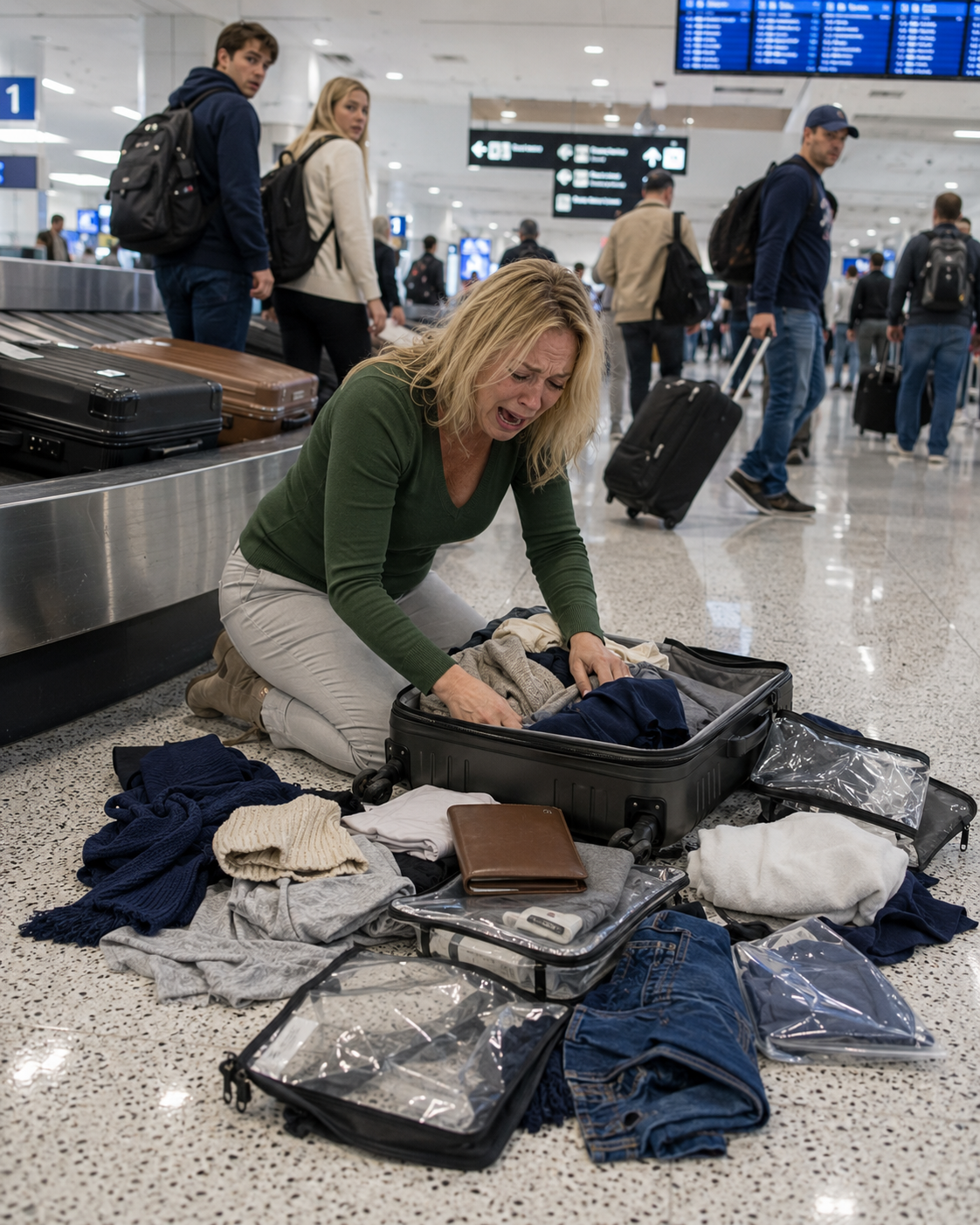
The upper suitcase crashed onto the floor and split open.
Julian’s belongings scattered across the polished terminal tiles.
Socks. Ties. Carefully folded shirts that still carried the faint scent of his cologne.
Fragments of a life that had ended without warning.
Travelers moved around me while I dropped to my knees and desperately tried to collect everything.
Tears blurred my vision.
My chest tightened until I could barely breathe.
Finally, an airport employee knelt beside me and began helping.
My own family lived less than an hour away.
Not one of them was coming.
I ordered a rideshare and sat silently in the back seat while rain tapped against the windows.
The driver attempted to speak to me twice.
Both times, I pretended not to hear.
When we arrived at the house Julian and I had shared, every window was dark.
The moment I stepped inside, freezing air surrounded me.
I left the suitcases beside the entrance and did not bother switching on the lights.
Instead, I curled into the armchair where Julian used to sit on Sunday mornings with coffee and the newspaper.
The silence felt unbearable.
It pressed against me from every direction.
I believed I was completely alone.
But I did not yet know that something inside the house had already begun to go terribly wrong.
Something my family had failed to notice.
Something that would break the silence before the night ended.
Soon, neighbors would rush into the street. Emergency vehicles would crowd the driveway, and news crews would arrive before sunrise.
By the time my family saw my home on the evening broadcast, it was far too late to erase the messages they had sent.
Part 2
The bridge club is meeting here tomorrow. Why don’t you book a hotel?”
I stood in the flooded kitchen, cold, hungry, and still grieving the man I had just buried.
Desperate to restore the heat, I went into the basement to check the electrical panel. The floor was wet and slippery. As I reached toward the box, I lost my footing and received a powerful electrical shock that sent me backward.
When I regained consciousness, I was disoriented and freezing. I managed to crawl upstairs and collapse on the sofa.
Then I heard the carbon monoxide alarm.
Beep. Beep. Beep.
The furnace had malfunctioned, and dangerous gas was spreading through the house.
My phone was only inches away, but I could barely move. My vision began to fade.
Then the front door crashed open.
“Fire department!”
My neighbor Diane had noticed water flowing from beneath my door and heard the alarm. She called emergency services, saving my life.
Part 3: The Broadcast
The cold rain of Portland washed against the blue emergency lights flashing across my front lawn. Paramedics wrapped me in heavy thermal blankets, oxygen mask strapped over my face, as firefighters hauled heavy black hoses through the doorway of my ruined house.
In the driveway, news vans were already setting up their satellite dishes.
The local news crew had been following a string of winter storm hazards in the neighborhood, but when they saw the fire department pull a newly widowed woman—barely conscious from carbon monoxide poisoning and a high-voltage electrical shock—out of a home where the pipes had burst, the story took an entirely different turn.
An investigative reporter named Sarah Vance approached the ambulance, microphone in hand, as the paramedics prepared to transfer me to Portland General Hospital.
“Ma’am,” she said gently, her tone filled with genuine concern as the camera red light glowed in the dark. “We heard from the fire chief that you had just returned home from overseas. Do you have any family nearby we can call?”
My vision was still hazy, the lingering effects of the gas making my voice raspy and thin. I looked down at my shivering hands, then at the phone resting on the gurney beside me. The screen was still illuminated, displaying the family group chat.
I couldn’t speak. I simply pointed at the glass screen.
Sarah picked up the phone, scanning the messages line by line.
Clara: My flight arrives at 5:00 p.m. Could someone please pick me up? Lucas: Today is hectic. Just call an Uber. Mom: Why didn’t you arrange this sooner? You know Tuesdays are difficult for everyone. Dad: Heavy rain is expected tonight. Be careful getting home. Mom: Your father and I have dinner with the Hendersons. We accepted weeks ago.
Sarah’s expression hardened. She looked from the screen back to my face, then toward my neighbor Diane, who was standing nearby wrapped in a raincoat, wiping tears from her eyes.
“Is this true?” Sarah asked Diane off-camera. “She buried her husband today?”
“Yes,” Diane sobbed, her voice carrying clearly over the news mic. “Her husband, Julian, died suddenly of an aneurysm abroad last week. She flew back all by herself. Her family lives twenty minutes away in Lake Oswego, but not a single one of them came. If I hadn’t seen the water pouring out her front door, she would have died in there tonight while they were out at dinner.”
Sarah Vance turned directly toward the lens.
“Reporting live from Northeast Portland,” she said into the camera, her voice dripping with quiet, devastating authority. “Where a grieving widow, returning home from burying her spouse overseas, was left stranded by her immediate family—only to face a life-threatening disaster alone.”
At 6:30 a.m., the morning news broadcast aired across the entire Pacific Northwest.
My mother, father, and brother were sitting in the pristine, sunlit kitchen of their Lake Oswego home, drinking espresso and preparing for their day.
On the wall-mounted television, the morning news banner flashed red: PORTLAND WIDOW SURVIVES NIGHTMARE AFTER OVERSEAS TRAGEDY.
My mother froze, her coffee cup suspended halfway to her mouth.
On the screen was a high-definition image of my house, cordoned off with yellow tape, water pouring down the driveway, fire trucks blocking the street. And right beside the reporter’s head was a zoomed-in, crystal-clear graphic displaying the exact screenshots of our family group chat.
Every text. Every timestamp. Every dismissive word.
Lucas: Today is hectic. Just call an Uber. Mom: Why didn’t you arrange this sooner?
“Oh, my God,” my mother whispered, her face going completely pale.
Before my father could speak, his cell phone rang. Then my brother’s phone rang. Then the home phone on the kitchen counter began chiming endlessly.
The broadcast hadn’t censored our last names. Local viewers, family acquaintances, business partners, and members of my mother’s country club had instantly recognized the chat logs.
Within fifteen minutes, my brother’s employer—a prominent regional law firm—had received over three hundred emails demanding to know why they employed an attorney who left his grieving sister to freeze in a storm. My mother’s bridge club members were already leaving furious messages, disgusted that she had chosen a dinner with the Hendersons over her daughter’s life.
My father opened his laptop. His corporate email inbox was exploding with messages from colleagues and board members asking one single question: Is this how you treat your own blood?
Part 4: The Hospital Room
By noon, the carbon monoxide had been flushed from my system, though my shoulders still burned from the electrical surge. I sat up in the hospital bed, the room quiet except for the rhythmic beep of the heart monitor.
The door swung open.
My mother, father, and brother rushed in. They looked frantic, disheveled, their phone screens lighting up repeatedly in their hands.
“Clara!” my mother cried, reaching out to grab my hand. “Oh, thank God you’re alive! What an absolute nightmare!”
I pulled my hand back slowly, placing it under the thin hospital blanket.
My brother took a step forward, his face flushed with a mixture of embarrassment and rage. “Clara, you have to call the news station right now. You need to tell them it was a misunderstanding. People are leaving terrible reviews on my firm’s website! Clients are canceling!”
My father adjusted his tie nervously. “Your mother and I have had our phone numbers leaked online, Clara. People are calling our home calling us monsters! We didn’t know the furnace was broken! How could we have known?”
I looked at the three of them.
For thirty-five years, I had shrunk myself to fit into their convenience. When Julian died, I had hoped that the sheer weight of my tragedy would finally make them see me. I had hoped that grief would be the bridge to bring my family close.
Standing in front of me now, they weren’t worried about my lungs, my burns, or the fact that I had nearly died on a cold sofa. They were worried about their reputation.
“You didn’t know the furnace was broken,” I said, my voice low, steady, and hollow. “Because you didn’t come.”
“Clara, please,” my mother pleaded, tears enfin appearing in her eyes—tears born of public shame, not motherly love. “We made a mistake. We should have picked you up at the airport. But to let that reporter put our personal family texts on television? Do you have any idea what the Hendersons are saying about us today?”
I let out a soft, humorless laugh.
“I buried my husband yesterday,” I said, looking my mother dead in the eyes. “And all you care about is what the Hendersons think.”
“We are your family!” Lucas shouted.
“No,” I replied, pointing toward the door. “Family is the woman who noticed water coming under my door and called 911. Family is the paramedic who held my hand in the ambulance when I couldn’t breathe. You three are just people I happen to share DNA with.”
My father took a step back, shocked by the cold steel in my tone. “What are you saying?”
“I’m saying you need to leave my room,” I said. “And you need to lose my number.”
Final Chapter: The Clean Slate
Two months later, spring had finally arrived in the Pacific Northwest.
The insurance company had completely restored my house. The damaged floors were replaced, a brand-new heating system had been installed, and the flooded kitchen had been rebuilt with warm, bright wooden cabinets that Julian would have loved.
I stood in the driveway on a clear, sunny Saturday afternoon, loading two large boxes of Julian’s clothes into the back of my SUV to donate to a local veterans’ shelter.
Diane walked across the lawn carrying two mugs of hot coffee.
“How are you holding up, Clara?” she asked gently, handing me a mug.
“Better,” I smiled, taking a sip. “Much better.”
My family had tried to reach out multiple times over the weeks—sending flowers, writing long, defensive letters, attempting to repair the damage to their social standing. But the public backlash had been swift and permanent.
My brother had been forced to take a leave of absence from his firm. My mother had resigned from her club committees, unable to face the cold shoulders of women who had once been her friends. The community had seen their true character in black-and-white text messages, and no amount of public relations could erase the truth.
I hadn’t responded to a single message.
I blocked their numbers, removed myself from the group chat, and changed my emergency contact information at the hospital and at work to Diane.
I closed the trunk of my SUV and looked up at the blue sky.
For years, I had thought that family was something you were stuck with—a debt you had to keep paying no matter how much it drained you. But as I stood in my quiet, peaceful driveway, surrounding myself with neighbors who cared and memories of a husband who had loved me unconditionally, I realized the ultimate truth.
Peace doesn’t come from forcing people to love you. It comes from having the courage to walk away from those who don’t.
I walked back into my warm, safe house, clicked the heavy oak door shut behind me, and turned the key in the lock—knowing that from this day forward, only genuine love would ever be welcomed inside.