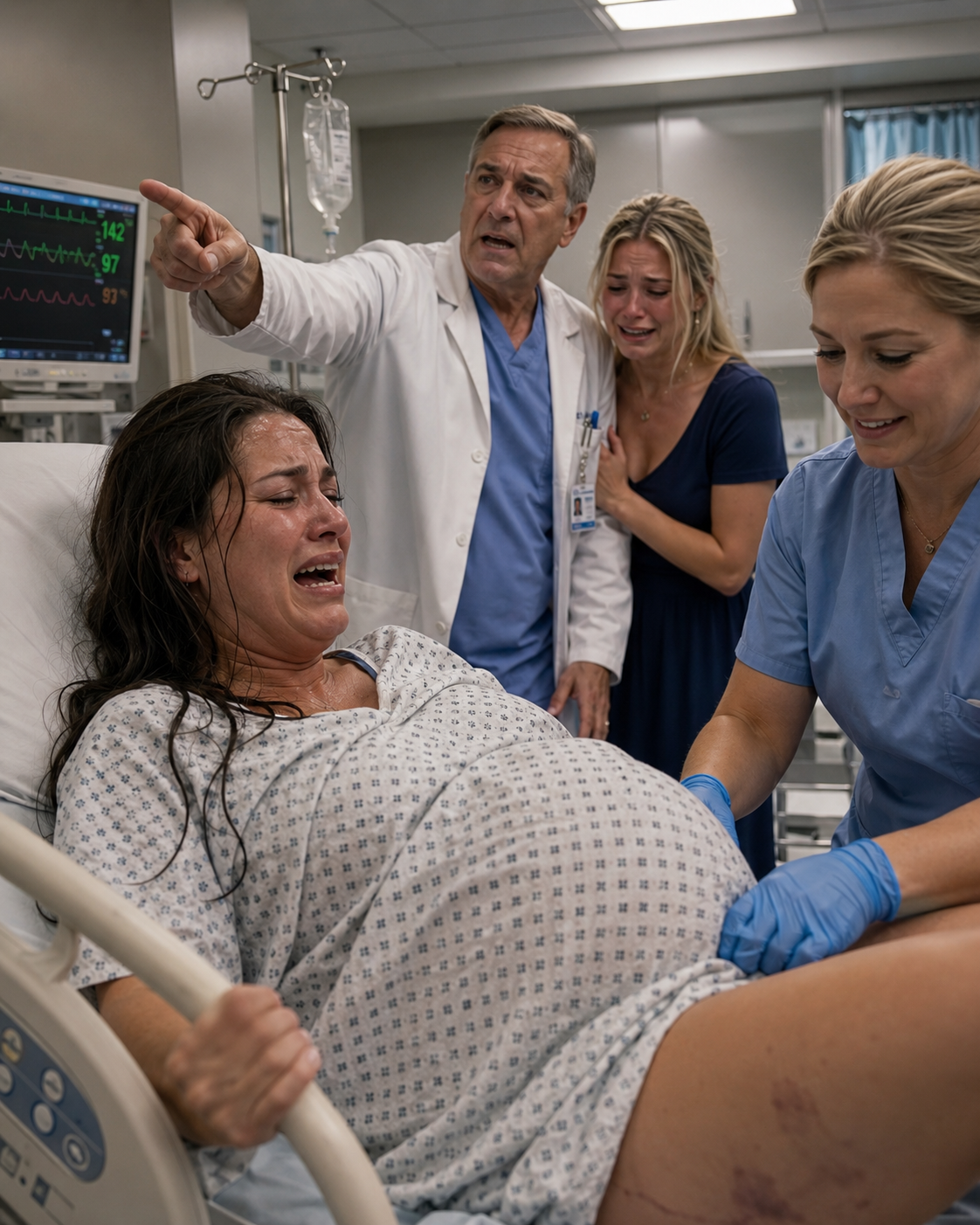

“Turn off the epidural.”
Those four words shattered the last illusion I still clung to.
For a heartbeat, I thought I had misheard.
The delivery room fell silent.
Even through the haze of unbearable contractions, I caught the horrified glance the assisting nurse shot toward my husband.
“Dr. Vance,” she said, her voice trembling, “the baby’s measurements are far beyond the expected range. Her vitals are deteriorating. We should perform an emergency C-section before—”
“I’m the attending physician.”
Julian didn’t even let her finish.
“I’ll decide how this baby is delivered.”
His voice was calm. Cold. Final.
I stared at him through blurred vision, waiting for the husband I’d loved for seven years to look at me instead of the monitor.
He never did.
The antiseptic burned my nose, but it couldn’t hide the metallic scent of my own blood. Every contraction felt as if my pelvis were being forced apart from the inside. My muscles shook uncontrollably, and warm sweat soaked the thin hospital gown clinging to my skin.
I knew exactly what my body was trying to tell everyone.
I was Aria Montgomery, Chief of Emergency Medicine.
I’d spent my career recognizing the earliest signs of catastrophe.
And right now…
I was watching one happen inside my own body.
“Julian…” My voice cracked. “He can’t fit. My uterus is under too much stress. Please… don’t do this.”
He finally looked at me. Not with concern. Not with love. With irritation.
“Aria, stop trying to run my operating room the way you run your ER.”
Every word struck harder than the contractions.
Not because he questioned my judgment. Because he dismissed me completely.
The man who once bragged that marrying another physician made him the luckiest man alive now spoke to me as if I were an inconvenience delaying his schedule.
Before I could answer, Serena stepped beside him.
Her eyes glistened with carefully rehearsed tears.
“Dr. Vance… please don’t be upset with Dr. Montgomery,” she whispered. “She only knocked over my medication tray because she’s in so much pain. It wasn’t intentional.”
Liar.
Less than a minute earlier, she’d leaned over me pretending to wipe the sweat from my forehead.
Instead, she’d dug her sharpened nails into the tender inside of my arm until I jerked from the pain.
The tray fell because of her. She knew it. I knew it.
But the only opinion that mattered belonged to Julian.
He didn’t even ask what had happened. He had already chosen who to believe.
I watched him soften when he looked at Serena.
I couldn’t remember the last time he’d looked at me that way.
Something inside me cracked.
Not a bone. Not a muscle.
Something far more difficult to repair.
Seven years of trust. Seven years of believing that no matter what happened, my husband would stand beside me.
The illusion died without making a sound.
“Hold her still.”
The order echoed through the room.
Three nurses hesitated. One of them swallowed hard.
“Doctor… this isn’t consistent with protocol.”
“If anything happens, I’ll take responsibility.”
No one argued again.
Hands gently—but firmly—pressed against my shoulders and legs.
They weren’t trying to comfort me. They were restraining me.
I looked up at the surgical lights until my eyes blurred with tears.
This wasn’t just physical pain anymore.
The contractions would end eventually. The betrayal wouldn’t.
I stopped pleading. Stopped explaining. Stopped hoping Julian would suddenly remember he wasn’t just my physician.
He was my husband.
Instead, I wrapped every remaining ounce of strength around one desperate thought.
Please… Let my son survive this.
Another contraction crashed through me.
I gripped the stainless-steel bed rail with everything I had left.
CRACK.
The sound echoed across the operating room.
Silence followed.
Every pair of eyes turned toward me.
The solid steel rail had snapped clean off in my hands.
Blood ran slowly from my palm, dripping onto the pristine white sheets.
The nurses stared in stunned disbelief.
For two long seconds, even Julian looked shaken.
I searched his face, praying—just once—that he’d finally see me.
That he’d realize this had gone too far.
Instead, his expression hardened.
“If you put that much effort into pushing instead of making a spectacle,” he said coldly, “our son would already be here.”
Then he stepped closer.
Moments later, a tiny, fragile cry finally filled the room.
“It’s… a boy,” one nurse whispered.
Relief flooded me for exactly one heartbeat.
Then her face turned white.
“Dr. Vance…”
The monitor began screaming.
“Her blood pressure is crashing…”
The EKG monitor shrieked its continuous, ear-piercing flatline alarm.
The room exploded into motion.
And I lay there, staring at my husband’s frozen face as he finally realized something was terribly, irreversibly wrong.
PART 2
His hands, soaked in my life force, twitched chaotically. He frantically began packing gauze, his arrogant composure shattering.
“Dr. Vance, you’re sweating. Let me get that,” Serena purred, stepping forward with gauze, treating my resuscitation like her personal runway. Julian didn’t push her away.
I am dying, I realized. But as the darkness swallowed my consciousness, my mind locked onto a single, chilling thought. If I survive this night, Julian Vance, I am going to dismantle your entire existence. Piece by bloody piece.
When I finally surfaced from the abyss, I was staring at the pale ceiling of a VIP recovery suite on the top floor of Manhattan General. There were no flowers. There were only the sterile drip of IV fluids and the rhythmic hum of life-support machinery. Outside the blinds, the neon pulse of the city cast long, freezing shadows against the walls.
A dense, radiating agony flared from my lower abdomen, as if ten thousand rusted razors were embedded in my flesh. As a veteran physician, I didn’t need a chart to calculate the devastation. The catastrophic blood loss had triggered severe necrotic tissue infections and multiple pelvic lacerations. They had salvaged my life, but my uterus was a graveyard. I would never carry a child again.
The heavy door clicked open. The dayshift charge nurse—a former cohort colleague who knew me well—slipped inside. Seeing me awake, she froze, her eyes instantly brimming with tears.
“Dr. Montgomery… you’re finally awake. Don’t move, the nerve blocks haven’t worn off.” She approached, her voice thick with genuine heartbreak. “Your son is in the NICU. Mild hypoxia, but he’s stabilized. He’s a fighter.”
“Where is my husband?” My voice grated like sandpaper against rusted iron, entirely devoid of emotion.
The nurse’s hand hesitated on the IV line. She couldn’t meet my eyes. “He… Dr. Vance finished your repair surgery. He claimed he was having a hypoglycemic crash from the stress. Nurse Serena was crying hysterically in the hallway. So… he took her out to Le Bernardin to get some dinner. To calm her nerves.”
I stared at the ceiling. A wife walks to the absolute precipice of death, drained of half her blood volume, her organs mutilated. She wakes up alone in a freezing room. And her husband—her attending surgeon—takes his mistress for a thousand-dollar French tasting menu to soothe her anxiety.
I didn’t scream. My heart rate on the monitor didn’t accelerate by a single beat. When absolute despair crosses the threshold of human endurance, grief evaporates. What remains is a surgical, predatory logic.
“Fetch my phone from the locker,” I ordered flatly.
The nurse’s eyes widened, but she didn’t question me. She rushed to the personal locker, grabbed my phone, and pressed it into my trembling, blood-stained palm.
I didn’t call Julian.
I didn’t call the police.
I dialed Arthur Sterling—the most ruthless, unforgiving medical malpractice attorney in the state, who also happened to owe me his life after I diagnosed his hidden aortic dissection three years ago.
He answered on the second ring.
“Aria? It’s midnight.”
“Arthur,” I said, my voice cold, sharp, and entirely devoid of human softness. “I need you to secure every inch of OR 4 footage from six hours ago. I need the telemetry logs, the epidural pump timestamps, and the surgical tray inventory before Julian Vance or Serena can alter them. I am filing for full legal custody, emergency termination of his medical license, and a multi-million dollar malpractice lawsuit. Do it now.”
Silence stretched over the line for three seconds.
“Consider it done,” Arthur replied, his tone shifting into predatory precision. “Are you alright?”
“I am alive,” I said flatly. “And that is going to be his biggest mistake.”
Two hours later, the heavy suite door swung open.
Julian walked in, smelling faintly of expensive wine and black truffle. Serena lagged slightly behind him, her lipstick reapplied, carrying a paper cup of designer coffee like an award trophy.
When Julian saw me sitting upright, clutching my phone, his expression flickered from irritation to a brief, practiced mask of spousal relief.
“Aria, you’re awake,” he said, stepping forward with an outstretched hand. “Thank God. The delivery was… complicated, but I saved you. You should be resting instead of—”
“Stop right there,” I said.
My voice wasn’t loud, but it cut through the room like a scalpel. He froze, his hand hanging uselessly in the air.
“Aria, please don’t be dramatic,” Serena chimed in, taking a timid step toward his shoulder. “Dr. Vance was so worried about you. He was practically shaking after the procedure…”
“Serena,” I said, turning my gaze to her. “If you take one more step into this room, I will have security escort you off hospital property for physical assault, starting with the fingernail marks currently being documented on my inner arm by forensic photography.”
Serena blanched, taking a frantic step back.
“What is wrong with you?” Julian snapped, his arrogance rushing back to cover his panic. “She was trying to help! You almost destroyed her tray—”
“The black box from OR 4 has already been subpoenaed, Julian,” I interrupted smoothly.
The color drained from his face so fast it was almost comical.
“What?” he whispered.
“The epidural pump logs show you ordered the cessation of analgesia without medical indication. The internal sensors recorded the fetal distress eight minutes before you ignored protocol. And the overhead camera captured Serena intentionally pressing her nails into my arm to provoke a reaction.”
I leaned back against the stark white pillows, watching the cold reality sink into his eyes.
“You didn’t just commit medical negligence, Julian. You committed assault under the guise of surgery. Arthur Sterling has already filed the emergency injunction. By 8:00 AM, the board will suspend your surgical privileges pending a criminal investigation. By noon, your name will be stripped from the hospital’s donor wing.”
“Aria, no… you can’t do this!” Julian took a panicked step forward, his voice cracking. “We’re married! We have a son! Think about my reputation—our family!”
“You killed my ability to ever have another child so you could play god and impress your mistress,” I said, my voice dropping to a whisper that shook the room. “You lost the right to call me your wife the second you told those nurses to hold me down.”
Three Months Later
The sun blazed brightly over the steps of the Manhattan Supreme Court.
I stood at the podium in a tailored navy suit, holding my healthy, thriving baby boy, Leo, tightly against my chest.
The court battle hadn’t been a battle—it had been a execution.
Faced with bulletproof telemetry data, video evidence, and the testimony of three horrified OR nurses who finally broke their silence, Julian’s defense collapsed instantly.
His medical license was permanently revoked.
The court granted me full, sole legal and physical custody of Leo, along with a total forfeiture of Julian’s marital assets to pay for the catastrophic damages he had caused. As for Serena, the hospital board terminated her immediately, and she was currently facing administrative charges for falsifying patient logs.
A pack of reporters swarmed the bottom of the steps, microphones thrusting into the air as Julian slunk out of the side exit, stripped of his title, his career, his wealth, and his family.
A reporter shouted from the crowd, “Dr. Montgomery! What do you have to say to Dr. Vance now that it’s over?”
I adjusted Leo in my arms, looking directly into the camera lens with a calm, unyielding smile.
“I spent years saving lives in the ER by making hard, precise decisions,” I said clearly. “Removing a tumor is no different than removing a man who mistakes his control for power.”
I turned my back on the cameras, stepped into the waiting car, and drove away into a life that was entirely, beautifully mine.